


climate economics
Green finance: public capital leverages private investment in sustainable businesses
New financial mechanisms are reducing uncertainty and increasing the flow of capital towards the climate agenda. This strategy underpins initiatives that have mobilised R$ 140 billion in funding for Brazil’s low-carbon economy.
Why is it important to tell this story?
Many sustainable projects that are essential to addressing the climate crisis involve technologies and business models not yet well established, thus increasing risks for investors. This story shows how Brazil and the UK have been developing financial mechanisms, technical assistance and incentives capable of reducing these uncertainties and attracting private capital to innovative environmental initiatives.
Partnerships and collaborations
The UK supports green finance initiatives through International Climate Finance (ICF), a global climate financing initiative. In Brazil, this work is conducted through such programmes as UKSIP and UK PACT, which involve partnerships with the federal government, subnational governments, the Inter-American Development Bank (IDB), the Eco Invest programme, the Brazilian Forest Service, financial institutions, companies and civil society organisations linked to the sustainable development agenda.
Mata N’Ativa Glossary
We are committed to promoting access to scientific knowledge. Be sure to explore the glossary to gain a clearer understanding of each of the concepts covered in the text!
Access Glossary
Brazil occupies a strategic position in the global sustainability market. Its vast reserves of freshwater, unique biodiversity, and electricity grid that is largely unreliant on fossil fuels make the country an ideal testing ground in the search for low-carbon solutions across various sectors – from biodiesel production to forest restoration. The favourable environment for projects and investment, with companies and governments open to partnerships, has the potential to cement Brazil’s role as a leader in what is known as ‘green finance.’
Initiatives in the sector are taking root across the country, in different regions and biomes. In Rio de Janeiro and Maranhão, the utility companies Aegea and BRK Ambiental are currently working on projects to expand access to water and basic sanitation for millions of people. With investments partially guaranteed by the United Kingdom, these major infrastructure projects are related to a key trigger: the achievement of greenhouse gas (GHG) mitigation targets through the use of innovative technologies, strategies and processes.
The idea is to promote the replacement of outdated practices with alternatives that have less environmental impact. The funds secured once the targets are met eliminate the risk from a business standpoint and open the door to a new reality – development allied with conservation. “We call this mechanism ‘performance-based incentives.’ The purpose of these funds is to implement more sustainable models and assess whether they are economically viable or not,” says Andres Comba, director of UK PACT and senior adviser on Green Finance at the British Embassy. If the initiative proves successful, this incentive can eventually be phased out, argues Comba, “because, if the economic model works, companies will continue to use it.”
Performance-based incentives are examples of how governments and multilateral organisations are working to leverage private-sector participation in innovative practices that yield positive results in terms of reduced greenhouse gas emissions, forest conservation and sustainable economic development. This is one of the pillars of the UK’s funding allocated to Brazil as part of an environmental and infrastructure agenda.

In the presence of the then Minister Marina Silva (centre), British Ambassador to Brazil Stephanie Al-Qaq (left) and President of the Inter-American Development Bank Ilan Goldfajn, the Ministry of the Environment and Climate Change launches the 3rd Eco Invest Auction in Brasília in November, 2025. Photo: Fernando Donasci/Ministry of the Environment and Climate Change
On various fronts around the world, Britain has thus far channelled at least R$ 4.5 billion through International Climate Finance (ICF), a UK government programme designed to help developing countries address climate change. Established in 2011, the ICF is the result of progress in multilateral discussions on the issue, such as the 2015 Paris Agreement, and stands as a symbol of the UK’s commitment to global climate leadership.
In practice, the ICF acts as an umbrella, with a wide range of programmes with distinct objectives operating beneath it. Among them is the UKSIP (UK Sustainable Infrastructure Programme), which will provide funding for the sanitation projects run by Aegea and BRK – approximately R$ 100 million and R$ 60 million, respectively, provided they meet the established targets.
The total funds earmarked for green finance channelled to Brazil add up to over R$ 1.2 billion, distributed across nine programmes in the areas of climate transition, forests, energy and agriculture. Comba emphasises, however, that the success of the partnership does not depend solely on direct financial contributions. “Collaboration between Brazil and the UK also involves building technical expertise, and this is difficult to quantify in monetary terms,” he says. One example of this effort is the work carried out with the Brazilian government to improve the operational processes in domestic green finance programmes and to help companies navigate this model.
This complements what the director of UK PACT defines as the two central pillars of the UK’s approach: first and foremost, working to ensure that Brazil’s financial system turns greener as a whole, with sustainability adopted as a strategic objective for financial institutions; and secondly, helping to create mechanisms to make such investments viable.
“These are long-term initiatives, and financial institutions aren’t used to them,” says Comba. Furthermore, he adds, the nature of some projects carry a great deal of uncertainty. “The work of forestry, for example, involves many risks that cannot be controlled. It is more complex to predict what the outcome will be in 20 years’ time.”
Despite the challenges, we are on a path from which there is no return. There is not enough public money to bring about a concrete transition to a new economy. One of the targets of Sustainable Development Goal 13 (SDG 13), established by the United Nations, is to mobilise US$1.3 trillion (R$6.7 trillion) by 2035 to finance climate mitigation and adaptation measures, including the transition towards cleaner energy sources. In order to do so, it is essential to strengthen sustainable finance.

The world has an enormous need to adopt mitigation and adaptation measures for projects, the cost of which no government will be able to afford on its own. It is essential to engage the private sector.
Andrea Minardi, professor and senior researcher at Insper, specialising in green finance
In response to this reality, the UK is shifting its focus: from a grant-based model to one centred on investment. Evie Robertson, private sector development adviser at UKSIP, explains:
“For us, investing in green finance is about how we can be more efficient and generate a broader impact in terms of financially viable solutions to these challenges,” says Robertson. In this context, Brazil is a treasure trove of opportunities. “Brazil has a very large capital market, with plenty of financial innovation, as well as political support and adequate infrastructure.”
Macaúba takes to the skies
In Bahia, the fruit of a common palm tree is set to provide an alternative for cleaner operations in the aviation sector. Macaúba is at the heart of a project for the development of sustainable aviation fuel (SAF) with initial investments of over R$4 billion. The initial tranche of this sum, R$500 million, was provided from public funds through the Eco Invest programme.
Launched in late 2024, Eco Invest is a Brazilian government initiative in the field of green finance and one of the world’s leading examples of blended finance. Since its inception, the programme – implemented in partnership with the Inter-American Development Bank (IDB) – has received support from the United Kingdom to ensure its efficient implementation.

A macauba plantation run by Acelen Renováveis in Bahia. With support from the Eco Invest programme, the project aims to produce sustainable aviation fuel from a native Brazilian palm tree capable of yielding up to ten times more oil per hectare than soya beans. Photo: Publicity/Acelen Renewables
“The UK has supported various initiatives for the technical development of the programme, such as funding consultancy work that helped us assemble the tools we have at our disposal,” explains Mario Gouvêa, a member of the programme’s Executive Board. “The partnership was crucial for us.”
Put simply, Eco Invest encapsulates the essential principle needed to drive green finance: using public capital as a catalyst for private capital in projects with initially uncompetitive rates of return or no real guarantees of success. Without this, argues Gouvêa, private capital would look to other projects with better prospects for profitability.
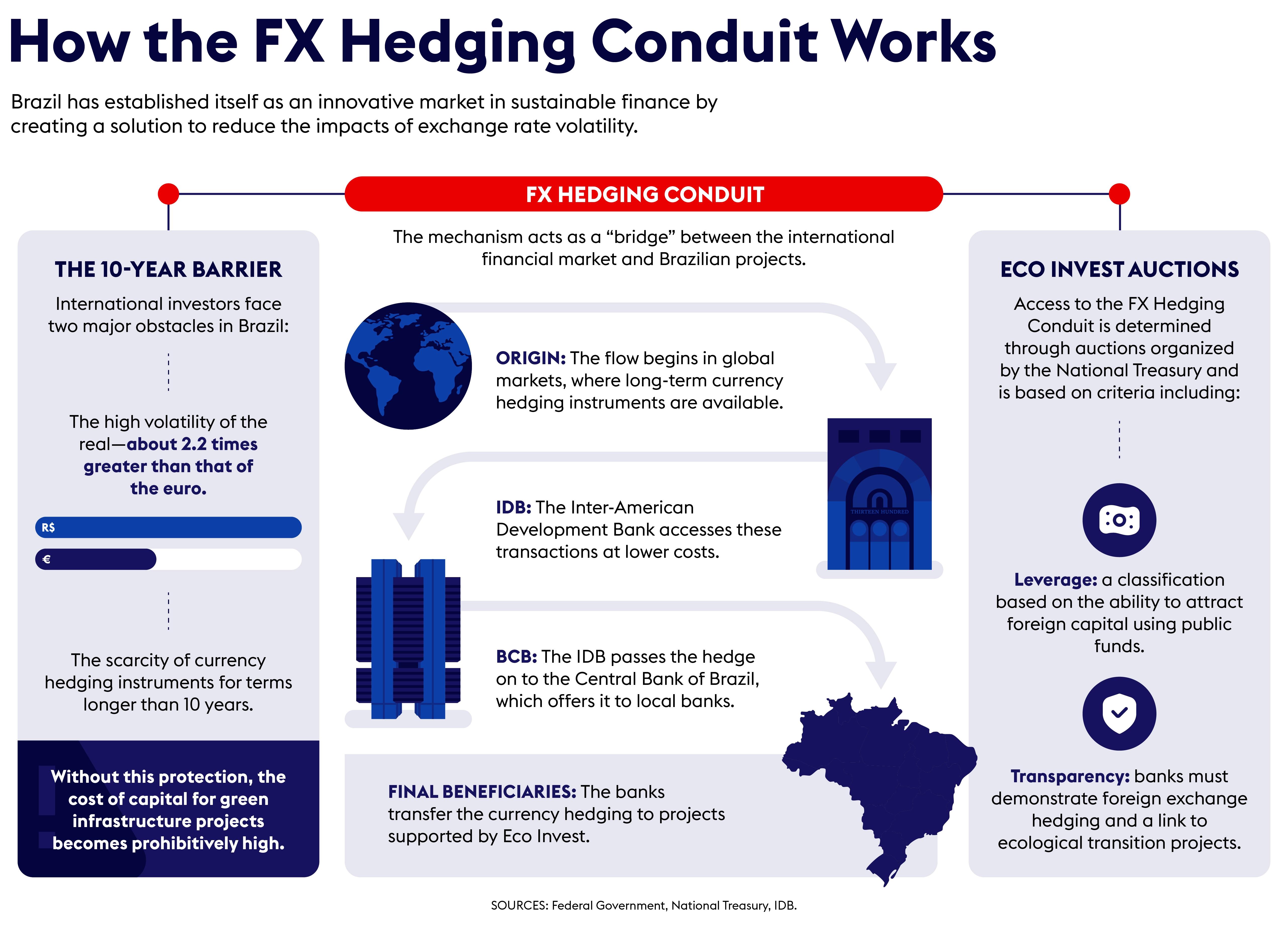
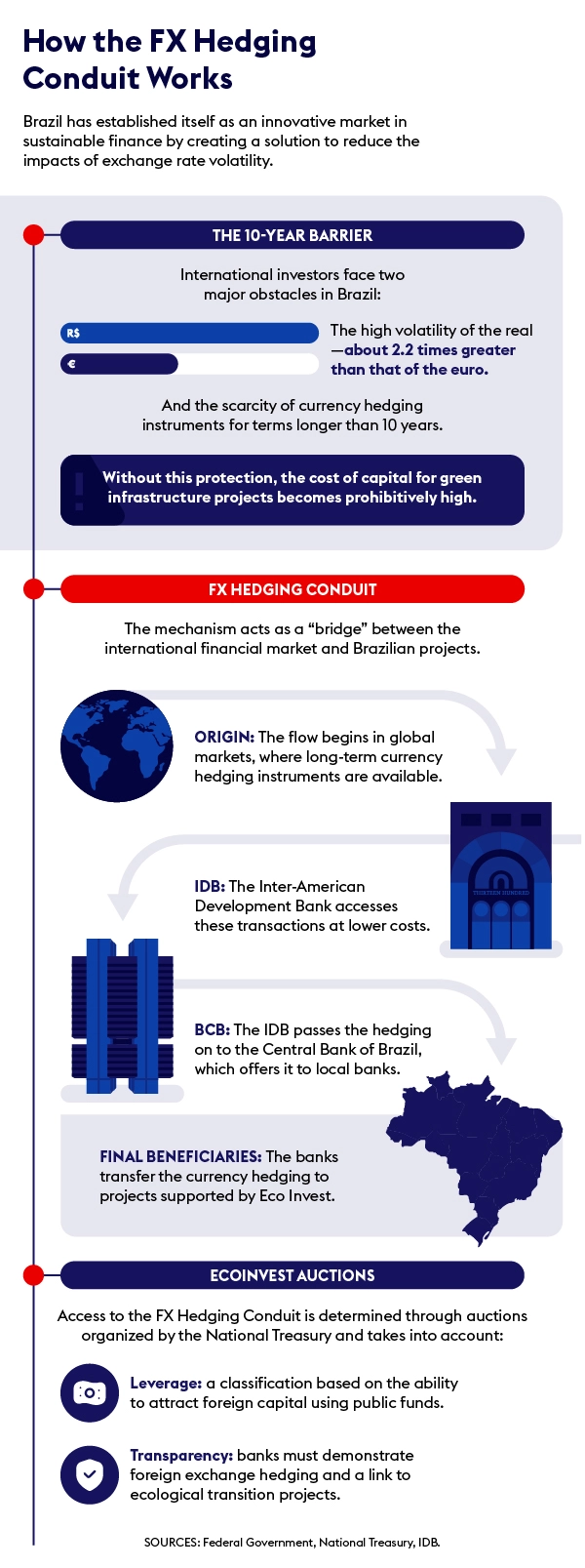
There are other obstacles in this equation. “Eco Invest deals with a lot of the barriers that investors face in sustainable projects,” says Andres Comba, of the British Embassy. In addition to the initial investment to mitigate risks, Comba cites protection against significant exchange rate fluctuations and assistance in structuring projects that explore new areas of business. “Eco Invest is addressing the main challenges in attracting private investment. That is why the programme is so innovative and delivers such positive results,” he says.
Eco Invest is structured around auctions, each with different models for incentivising private investment. In the first, launched simultaneously with the programme in late 2024, the federal government offered funds to financial institutions to support projects with a leverage ratio of six to one. Putting the concept into figures, this means that if a public bank were to invest R$ 100 million, then R$ 500 million in private funds would be required as a counterpart to bring the total investment up to R$ 600 million. In this first round, there was also a requirement for participating companies to use foreign capital.
One of the participating banks was HSBC. The British bank raised R$ 500 million from the federal government for the macaúba sustainable aviation fuel project. Acelen Renováveis, an energy company set up by Mubadala Capital, is responsible for implementing the project, with an additional R$ 3.5 billion allocated for the venture. “Acelen is the first company in the world to receive investments to create an integrated project for these end products – that is, from seed to fuel,” says Maíra Peruzzo, Institutional Relations Manager.
With the participation of Eco Invest, Acelen is building a biorefinery in Bahia that will be integrated into the company’s production complex, featuring agricultural research laboratories where work is being conducted to genetically improve the macaúba. This has already made it possible to develop seeds with a germination rate of over 80%, compared to less than 5% in the wild.
Peruzzo explains that the fruit was chosen for its natural characteristics. Macaúba requires little water to grow and is suitable for planting in already degraded areas. Furthermore, it is very oil-rich and produces ten times more oil per hectare than soya, for example. Finally, biofuel made from macaúba is ‘drop-in ready’ for the aviation industry, meaning it requires no modifications to existing aircraft.
Acelen hopes to produce one billion litres of macaúba oil per year within ten years from a planted area of 180,000 hectares along the corridor between Montes Claros, in the north of Minas Gerais, and Salvador, with a focus on the Recôncavo Baiano region. Of this total, 36,000 hectares will be managed by family farmers. “We bring together all the elements of the bioeconomy through nature-based solutions,” says Peruzzo. Acelen also works closely with farmers to provide training, assist with land title regularisation and secure financial guarantees.
It is an ambitious proposal, with an uncertain outlook, but one that needs to be implemented at this very moment. “Since it is a new project, banks and investors are looking for benchmarks. Even insurers find it difficult to assess the true risks. There is no data,” explains the Acelen manager. In this context, “blended finance means believing in the sector’s development and providing that security for investors.”
Blended finance is precisely the model used in Eco Invest’s first auction. Subsequent auctions under the programme are trialling other mechanisms to attract private funding to the sector, such as greater involvement from investment funds. In total, Eco Invest has mobilised R$ 140 billion in sustainable investments for Brazil thus far. There are projects including biorefineries, enzyme plants to improve biofuel productivity, and sanitation and wastewater treatment projects, among others. “Previously, the ESG (Environmental, Social and Governance) sector was somewhat hidden within the banks; it was merely a formality,” says Mario Gouvêa. “Now, thanks to the contribution from Eco Invest, it is taking centre stage.”
In early-stage discussions, other countries have also shown interest in adapting the model, with the UK even taking part in these talks. “We have a very valuable technical partnership with the UK,” says Gouvêa. “Eco Invest uses funds from the Brazilian government, but we had no way to pay for certain consultancy services, which wouldn’t have been commissioned at the pace that we needed. Their help was very important.”

Thanks to blended finance, which combines funding from the UK Pact programme with private investment, a large proportion of the sleepers – the wooden beams that support the tracks – for the London Underground are manufactured in Brazil, using sustainably sourced red angelim, pedra angelim, cupiúba and pequi timber. Photo: Winston Tjia
The forest stands tall
While investment in biofuels involves a high degree of risk, other initiatives are even more uncertain. In March, the Brazilian Forest Service awarded the first concession for forest restoration in Brazil. The model is unprecedented. The company Re.green won the tender to invest R$ 87 million over 40 years in the restoration of more than 6,000 hectares within a 51,000-hectare area in Bom Futuro National Forest (Flona) in Rondônia. The project is expected to reduce greenhouse gas emissions by the equivalent of almost two million tonnes, which Re.green can then sell on the carbon credit market. Furthermore, there are prospects for significant job creation in the region.
“It is an innovative project in terms of green finance, even in the global context. It’s a win,” says André Chaves, manager of the Forests and Restoration department at Imaflora, a Brazilian organisation that has been working in the environmental sector for 30 years. With funding from UK PACT amounting to around R$ 10.7 million, Imaflora is working in partnership with Systemiq, a consultancy firm specialising in the green economy, alongside the Brazilian Forest Service to optimise a series of processes within the forest concession system.
For Chaves, this is the first step in encouraging other stakeholders to enter a market in which Brazil’s internationally declared target is to restore 12 million hectares by 2030. “It is a huge sector and one that will get even larger with the consolidation of the carbon market,” he says.
Funding from UK PACT and the work of Imaflora “were instrumental in structuring this first restoration concession”, explains Renato Rosenberg, Director of Concessions at the Brazilian Forest Service. The partnership began in 2024, initially focusing on agreements for forest management and timber harvesting – concessionaires are permitted to harvest up to five trees per hectare per year, according to a rotation system whereby a hectare can only be worked again after 30 years.
Established almost 20 years ago, the concession programme in the National Forests is gradually expanding across the Amazon, yielding positive results in terms of reducing deforestation, generating revenue for concessionaires, income distribution and impact on the local economy.
Madeflona was one of the first companies to be awarded a forestry concession, in Jamari National Forest in 2008. In 2013, the company took over a second area, in Jacundá National Forest, and in 2019 a third, again in Jamari National Forest. Madeflona currently manages a total of 140,000 hectares for timber harvesting.
At first, there was a great deal of uncertainty about how this collaboration with the government would work out. But, over time, we realised that what had seemed like a utopian dream of the researchers working on forest management actually worked in practice
Evandro Muhlbauer, director of Madeflona
In addition to putting into practice the theory that standing trees have greater value – both financial and environmental – the concession model also provides legal certainty for the companies involved. Its clients include manufacturers of lorries and agricultural machinery, high-end furniture makers, the construction industry, and producers of sea defences in the Netherlands and railway tracks in Brazil, the United States and England.
In London, the company Timber Fox uses Madeflona’s materials in the Underground’s sleepers – the wooden logs upon which the tracks rest. Madeflona’s director explains that these components require specific physical characteristics, such as low vibration and greater strength, due to the stress to which they are subjected. The four tree species harvested by the company – red angelim, pedra angelim, cupiúba and pequi – possess precisely these characteristics. Furthermore, says Muhlbauer, Timber Fox is rigorous in terms of supply chain sustainability.
Although the results are positive, there is room to expand forest concessions, says Renato Rosemberg. Demand for timber in the Brazilian market stands at 12 million cubic metres per year. Some 20 million hectares of sustainably managed forest would be required to meet it. However, considering federal concessions alone, the current total is just 1.3 million hectares.
One of Imaflora’s objectives is to assist in this expansion. “Indirectly, we increase the operational capacity of the Brazilian Forest Service. And, in doing so, we accelerate this process,” explains André Chaves. Another aspect of the project, developed with funding from UK PACT, is to facilitate the local authorities and states’ access to the resources to which they are entitled under the concessions.
The management concessions are spread across eight cities in Pará and Rondônia, many of which have an extremely low Human Development Index (HDI). Due to red tape, it was common for local municipal councils to never actually see any of the money. “Through this partnership, we provided technical training to the municipalities’ environmental departments to facilitate the transfer of funds,” explains Chaves.
As a result, over R$ 10 million was allocated to Pará, almost R$ 3.5 million to Rondônia, and R$ 9.4 million to the municipalities of Faro, Itaituba, Melgaço, Orixminá and Terra Santa. The impact on job creation is equally significant. For example, Madeflona employs an average of 450 people throughout the year in Itapuã do Oeste, a town in Rondônia with a population of of 10,000.
Still, the difficulty in securing investments for sustainable projects remains a barrier in this market. Evandro Muhlbauer, director of Madeflona, and Renato Rosenberg, of the Forestry Service, are unequivocal in stating that a lack of resources prevents concessionaires from optimising research into new species with economic potential, acquiring suitable machinery and providing technical training. Were this not the case, it would be possible to double productivity.
At any rate, an initial path has been forged. “The challenges, both in terms of climate change and the conservation of the Amazon, are enormous. They may well be the greatest challenges in human history,” says Renato Rosenberg. “There is no silver bullet. We are going to need a range of stakeholders and models. And the private sector, in partnership with governments, is very important.”
Projects supported by the United Kingdom
The work involves partnerships with federal and state governments and civil society organisations, as well as research centres.
The path to green finance
Taking into account all International Climate Finance investments worldwide, the UK estimates that nearly R$ 71 billion in private capital has been mobilised since 2011. It is an upward trend, with the amount invested rising each year.
This trend confirms the view put forth by Andres Comba, director of UK PACT and senior adviser on Green Finance at the British Embassy. “Investor interest is high. The obstacle is that there is no way to link this demand to a ready supply with mechanisms to reduce risk,” he says. Hence the importance of capacity-building and technical assistance to help make these initiatives viable.
According to Marcelo Soares, head of Global Banking at HSBC – an investor in Acelen’s Eco Invest project – public capital, backed by clear rules and complementary technical support, is what boosts investment decisions. “As a bank, when the framework creates an environment that is predictable for projects, private capital scales up,” he says.
Achieving this outcome requires a wide range of mechanisms. These include technical capacity-building, currency hedging, joint blended finance investments to reduce risk, and performance-based incentives, all of which necessitate dialogue with suppliers and potential customers for family farmers. In short, a high degree of market alignment.
As this ecosystem becomes more consolidated, the range of potential investors expands, according to Andrea Minardi, a lecturer at Insper. And as projects yield positive results, capital is channelled into other initiatives; for example, wind and solar power plants. “When it first started, it was extremely expensive and had to be subsidised. Now, that’s no longer necessary,” she says. “It still takes subsidies to produce green hydrogen.”
Even against a backdrop of geopolitical instability, the green finance movement remains steady. Positive results and market appetite ensure its continuity. “The course has been set; there’s no turning back now,” says Minardi. “Who’s going to ignore climate risk from this point on? Who’s going to ignore water stress?” The only way to go now is forward.
This story was produced with support from the UK government’s International Climate Finance (ICF) programme, through an institutional partnership with the British Embassy in Brazil. This is sponsored content, developed by Mata N’Ativa based on research and interviews.
GLOSSARY
Electricity mix
The range of sources used to generate electricity in a country
Biodiesel
Biofuel produced from vegetable oils or fats, used as an alternative to fossil diesel
Low-carbon solutions
Solutions that emit little or no carbon in energy production
Greenhouse gases (GHGs)
Gases that trap heat in the atmosphere, such as carbon dioxide, and cause global warming
Sustainable Development Goals (SDGs)
17 global goals established by the United Nations (UN) to guide countries, businesses and society in the pursuit of a fairer world that protects the environment
Capital market
Environment in which companies and governments raise funds from investors to finance projects and economic activities
Exchange rate fluctuations
Changes in the value of one currency relative to another, which can affect international prices, revenues and investments
Biorefinery
An industrial facility that converts biomass to fuels, energy and other products of economic value
ESG (Environmental, Social and Governance)
A set of criteria used to assess the environmental, social and governance performance of a company or investment
National Forest (Flona)
A sustainable-use conservation area dedicated to the protection of forests and the responsible management of natural resources
Legal certainty
A state in which laws and regulations are clear and stable, providing predictability for individuals, companies and investors
