Genomics of the Brazilian Biodiversity
Invisible footprints: how DNA traces help conserve species
The Environmental DNA Metabarcoding technique allows identifying multiple species using soil, water, or even air samples.

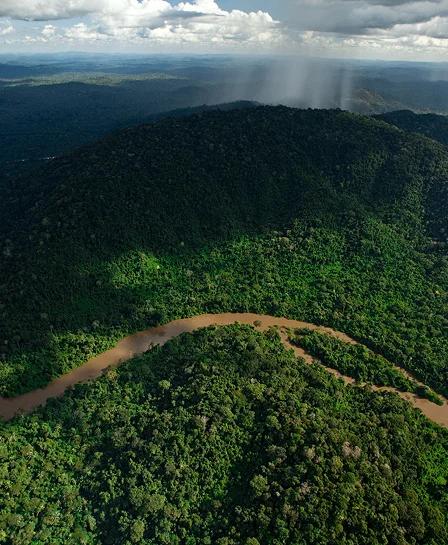
In June 2024, researchers from ICMBio and ITV collected 219 environmental samples – including soil and leaf litter – in the Tapajós National Forest, in Pará, pictured above. PHOTO: André Dib
Why is it important to tell this story?
This story shows the possibilities and challenges of scientists' work with Environmental DNA Metabarcoding, a tool that deepens the knowledge of biodiversity and can improve conservation actions, including for endangered species.
Partnerships and collaborations
The Genomics of the Brazilian Biodiversity (GBB) project is led by the Vale Institute of Technology and the Chico Mendes Institute for Biodiversity Conservation. More than 300 researchers from national and international institutions such as the University of São Paulo, the Federal University of Pará, and the University of Oxford in the UK are participating, as well as hundreds of organizations like Ibama and Fiocruz.
Mata N’Ativa Glossary
We work for access to scientific knowledge. Be sure to explore the glossary at the end of the story to get a clearer understanding of each of the concepts covered in the text!
Access Glossary
Wearing gloves, a long-sleeved shirt, boots, with her hair tied up and a surgical mask, biologist Luanne Lima holds a spray bottle with a decontaminating liquid and a spatula. The researcher stands among the trees and prepares to collect soil samples. The collected material will be packed in small hermetically sealed plastic bags and kept on ice until it is sent to a laboratory. In the samples, scientists search for DNA molecules that can provide answers for ecosystem monitoring, the presence of invasive species, and environmental pathogens.
The DNA can come from skin cells, mucus, feces, saliva, and even dead organisms present in the samples collected by the researchers. “With just one sample, we can identify all the vertebrates, invertebrates, or microorganisms that have passed through that soil,” says Lima, a collaborating researcher at the Chico Mendes Institute for Biodiversity Conservation (ICMBio). “It’s possible to conduct large-scale monitoring of a given environment in just one field expedition,” the biologist says.
A few days after the samples arrive at the laboratories, it is possible to obtain valuable information about species that move through the soil – as in the case of the material collected by the biologist –, as well as in water and even those that leave traces in the air. The extracted DNA is sequenced, and a world of possibilities opens up to the trained eyes of scientists in a record time of a few weeks. For comparison, traditional methods of observation and camera traps can take months or years to generate data on species in certain environments.

Researchers collect a soil sample for environmental DNA analysis in the Tapajós National Forest in Pará. PHOTO: Rodrigo Avelar / Vale Institute of Technology Collection

“With just one sample, we can identify all the vertebrates, invertebrates, or microorganisms that have passed through that soil”
Luanne Lima, collaborating researcher at ICMBio
Invisible footprints revealed
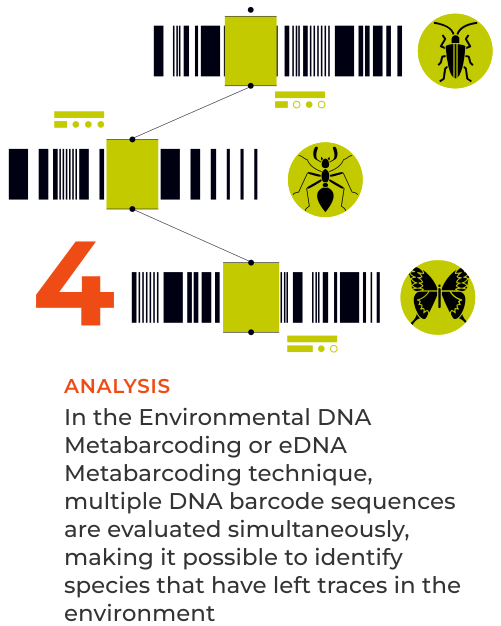
The technique of Environmental DNA Metabarcoding, or eDNA Metabarcoding, is used to simultaneously evaluate multiple barcode sequences, that is, DNA barcodes. The tool works in the same way as barcodes on supermarket products, but instead of prices, it accurately identifies species of living beings.
This approach is among those used by researchers from the Genomics of the Brazilian Biodiversity (GBB) scientific consortium. A result of a partnership between the Vale Institute of Technology (ITV) and ICMBio, the consortium will generate genomic data on Brazilian fauna and flora, including 80 reference genomes, one thousand population genomes, and 1,600 DNA barcodes. The objective is to generate genomic data to support conservation policies and the development of the bioeconomy in Brazil.
A single environmental sample can contain thousands of DNA fragments. “It’s as if living beings leave invisible footprints wherever they go,” explains Jacqueline Batista, coordinator of the Thematic Laboratory of Molecular Biology (LTBM) at the National Institute of Amazonian Research (INPA). “So, through laboratory methodologies, it’s possible to detect who left that footprint and, sometimes, determine the path that was taken,” she says.
Each “footprint” can be identified in existing genome databases. After sequencing, one just needs to search for the sequence of DNA letters found in the sample within databases. This technique is particularly useful for studying organisms that are difficult to detect or capture, such as microorganisms and rare or cryptic species.


One sample, several discoveries
The advantage of Environmental DNA is identifying multiple species without the need to collect individuals, using only the DNA extracted from the traces they left in the environment they passed through. “Imagine I want to know if there is pirarucu in a lake in a certain region, but I don't want to have to fish for it. So I can collect a water sample from that lake and, without touching the fish, I can know if it lives there,” Batista exemplifies. “It's a non-invasive methodology that allows us to have a snapshot of that moment in that environment,” she says.
One of the challenges, however, lies in the amount of data available to identify and compare changes that may have occurred over time in the DNA of the studied species. “Since it is a technique widely used to identify rare or elusive species, which are difficult to see, it can happen that either the DNA is in low quantity in the sample and you can't identify it, or the species is so different that even with the sequenced DNA you can't find its relative sequence in the databases,” comments biologist Izabela Santos Mendes, a GBB collaborator. “If the reference database is not sufficient or if a sequence is not there, it is not possible to identify the species,” summarizes the researcher.
Biologist Luanne Lima recalls a collection she did in the Pantanal. “Initially, although I had collected near giant otter latrines, its barcode was not identified in the database search, which had very few sequences, some with errors. So I saved that result and, two years later, I searched the database again and very good sequences had been entered, so I could make the identification,” says the biologist. For her, the quality and comprehensiveness of the databases are crucial for the accurate identification of species.
Environmental DNA Metabarcoding is a relatively new tool: it emerged in the 2000s, but there are references to the technique since the late 1980s. With the advancement of technology and the improvement of bioinformatics, access to genetic data has become part of the daily routine of researchers in the area. “In the past, the techniques were much more laborious, more complicated, and more expensive,” says José Augusto Bitencourt, a researcher at ITV and a member of the GBB management committee.
In an attempt to lower costs and speed up the work, in November 2024 a Brazilian team placed third in the international Xprize Rainforest competition. The challenge was to conduct, in 24 hours, a biodiversity survey in a 100-hectare area of the Amazon Rainforest with remote collection equipment. The data analysis had to be done in two days. For this, one of the bets of the participating teams was Environmental DNA Metabarcoding.


eDNA Metabarcoding and species conservation
The use of the technique is being tested in the National Biodiversity Monitoring Program, also called the Monitora Program, of ICMBio. “It is a long-term initiative, because monitoring is something that happens over the long term, or even indefinitely,” says Rodrigo Jorge, coordinator of Biodiversity Monitoring at the institute.
For ten years, the Monitora Program has been monitoring species, habitats, and ecological processes, such as pollination, in all Brazilian biomes. The program applies two types of protocols: the basic one, which must be simple, low-cost, and applicable by non-specialists, and the advanced one, which is more expensive and depends on the work of specialists.
In the advanced protocols, different techniques are used, such as camera traps and field expeditions with the help of people from local communities. Due to the difficulty of monitoring Brazilian biodiversity in its entirety, ICMBio establishes certain groups of interest for continuous monitoring.
With the implementation of the Genomics of the Brazilian Biodiversity consortium, the Monitora Program began conducting tests using Environmental DNA Metabarcoding as an advanced monitoring protocol. In 2024, two expeditions were carried out to collect materials. In the first, in June, scientists gathered 219 samples, such as soil and leaf litter, in the Tapajós National Forest (PA).
The second, in September of the same year, was carried out in the Cajari River Extractive Reserve (AP) with a focus only on water collection. The scientists carry syringes with an attached filter that separates the DNA from the other elements present in the water. In total, 195 samples were collected. The project's objective is to identify fish, mammals, birds, reptiles, amphibians, and invertebrates of the Amazon biome.
In 2025, ITV and ICMBio researchers plan to carry out collections in coastal marine environments and, in 2026, in open fields. The locations were selected based on the existence of time series data generated by the Monitora Program. If it works, the methodology could be implemented as an advanced monitoring protocol for the ICMBio project in different regions of the country.
The intention, however, is not for the Environmental DNA Metabarcoding approach to replace other techniques already applied by ICMBio within Monitora, but to be a complement. “It is a technology that can provide a very interesting complementary response for the project, as it allows for expanding the monitoring targets, detecting species that are difficult to find with sampling methods, assessing whether the presence of any species has increased or decreased in that location, and generating several important indicators,” says Jorge.
One of the objectives is to compare the data found through Environmental DNA collections with those already generated by the Monitora Program over the last ten years. “By sequencing, we not only see the species that circulate there, but we also identify invasive species, understand the diet and food chains, and know what happened to a species after major environmental changes, such as fires,” explains biologist Luanne Lima.


Researcher Luanne Lima performs water filtration using a syringe for environmental DNA collection PHOTO: Rebeca Hoefler
Data and challenges in large scale
A handful of collected material can generate such a large volume of data that, in some cases, only a supercomputer can process it. Consequently, analyses of various species from different biomes can take months to complete. “Everything comes in computer language, so it needs to be translated to analyze the content, which demands time and resources,” comments Bitencourt.
In addition to laboratory infrastructure, the use of Environmental DNA requires investment in human resources, that is, people trained to collect, sequence, and analyze the specific samples for Environmental DNA Metabarcoding. Since the beginning of the consortium, 29 ICMBio staff and fellows have been trained in eDNA Metabarcoding sample collection and 9 in data analysis. “It is a new technique, so there are not many specialized people, especially outside the Southeast and, in particular, in the North of the country, where we are operating,” observes Bitencourt.
With more trained people, it becomes easier to envision a future where data generated by eDNA will support public policies and management strategies for biodiversity conservation. “It is a technology that adds a lot to the work involving monitoring and detection of threatened species,” says Batista, coordinator of the Thematic Laboratory of Molecular Biology (LTBM) at INPA.
GLOSSARY
Bioinformatics
an interdisciplinary field that combines biology, computer science, and mathematics to analyze, interpret, and understand complex biological data
Open fields
open plant formations, with a predominance of grasses and few trees or shrubs, present in the Pampa, Cerrado, and Caatinga biomes
DNA barcodes
a species identification technique based on the analysis of a small standard stretch of DNA; just as a barcode on products quickly identifies an item in the supermarket, the DNA barcode quickly identifies a species by comparing its DNA stretch with a database.
Cryptic species
a term used to describe species that are morphologically very similar (or almost identical), but are genetically distinct and do not interbreed naturally
DNA
a fundamental molecule for heredity and cellular function; DNA (deoxyribonucleic acid) contains the genetic instructions necessary for the development, growth, reproduction, and maintenance of living organisms, from bacteria to humans
Environmental DNA Metabarcoding
a technique used to study biodiversity and biological communities from the DNA present in environmental samples; it allows for the identification of multiple species at the same time
Reference genome
a DNA sequence that serves as a model or standard to represent the complete genome of a species, exemplifying its genetic organization; it is used for comparisons and analyses of genetic variations among individuals, populations, or species
Population genome
the set of genetic variations within a population of organisms; the study of the population genome examines how DNA varies among individuals of the same species in different geographic locations, time periods, or environmental conditions, allowing for the calculation of important parameters indicating the risk of species extinction
READ MORE
by Leticia Maia
Consortium brings together hundreds of researchers to map genomes of Brazilian species
August 25, 2025
by Ana Rita Martins
Genomic study could improve management and conservation efforts for pirarucu, an important species in the Amazon bioeconomy
August 25, 2025
by Letícia Naísa
Understand how getting to know the Itacaiúnas river basin can help conserve the entire Amazon
September 25, 2025